
weather modification systems
UAS with payloads can measure meteorological state parameters, wind and turbulence and other variables. Weather modification technologies may be effectively applied to facilitate the water and energy cycles,. It has been predicted that more than 40% of the world’s population will live in water-stressed areas by the decade of the 2020s
Verisk’s 2018 report, Hail: The Hidden Risk, says that in 2017 more than 10.7 million properties in the United States were affected by one or more damaging hail events. The number of properties affected in 2017 was lower than the 12.6 million properties affected in 2016. Verisk’s report, U.S. Hail Damage Insights, shows that in 2019, more than 7.1 million U.S. properties were affected by one or more damaging hail events, resulting in losses of more than $13 billion.
According to Verisk’s 2021 report, The Hail Hazard and Its Impact on Property Insurance, 6.2 million properties in the United States experienced one or more damaging hail events in 2020, about a million fewer than in 2019. 2020 claims resulted in almost $14.2 billion in losses. Texas had the highest number of properties affected by hail, over 1.5 million properties.
Limited advances have been made in the development of present- day weather modification (cloud seeding) technologies and the ability to recognize treatable clouds.
The functional components of the a-priori framework with the greatest need for advanced technology and technique development fall into the following general areas:
- Cloud seeding activity monitoring and simulation;
- Seeding agent delivery and dispersion;
- Cloud seeding evaluation technology, techniques and protocols.
In the case of warm clouds, one could conceptualize that hygroscopic seeding with optimally sized particles could produce drizzle drops that lead to more rainfall. Operationally seeding warm clouds has been with the physical and chemical properties of the seeding agent and delivery by means of aircraft.
Anti Hail
The hail is a natural disaster that causes a lot of damage, especially in agriculture. One of the basic method is the inserting of meteorology active substances in a cold part of the cloud, a large number of particles that are representing centers of condensation or crystallization. Anti hail UAS quickly can seed large cloudy mass, with large quantities of reagents.
The latest anti hail technology requires piloted aircrafts to enter the dangerous zone next to Cumulus clouds and eject or burn flares. This is very expensive :
- certifying the aircrafts
- keeping the pilots on duty on shifts
- risking the pilots life
No aircrafts can enter storm clouds. So the flares are ejected above or below the cloud.
Our project make this process much simpler:
- Using low cost UAS
- Very effective – Entering the cloud and ejecting the chemicals in the exact position
- No expensive pilots on duty.
- Not risking life’s
- 24/7 operation
- The aircraft can be piloted from any location on earth.
- Automated missions
- Long range (1200 km radius)
Main benefits
- round-the-clock and all-weather capability;
- precision and selective engagement of seeding clouds
- capability to perform missions at a large distance
- high flight safety and survivability;
- independent stationing and operation capability
Authomated Clowd seeding and Fertilization UAS "CS"


The aircraft is a single-engine high-wing aircraft with a strut-mounted wing, a pulling propeller and retractable landing gear.
Payload 300 kg, flight range 900 km.
The main mode of operation is the cruising flight of the aircraft at a speed of V = 300 km / h and an altitude of up to H = 3 km under standard atmospheric conditions
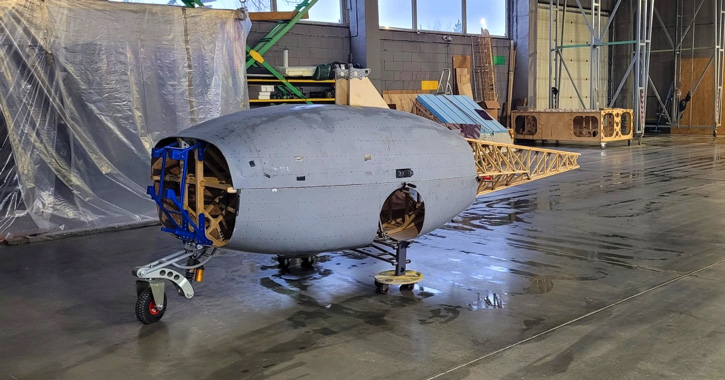
1. Can be transported 4pcs in a truck. Quick preparation for the flight.
2. Cruising speed of 100-150 km/h, so that the aircraft can fertilize large areas.
3. High safety.
4. Low operating costs, economy and environmental friendliness.
Single-engine high-wing aircraft with a strut wing, a pulling propeller and a retractable landing gear.
The main mode of operation is the cruising flight of the aircraft at a speed of V = 100 km / h and altitudes of 10-20m.
The design of the aircraft consists of the following units:
fuselage:
-central part;
-tail boom;
-engine compartment;
wing:
-center section;
-right and left wing consoles;
-right and left struts of the wing console;
plumage
-keel and rudder;
-right and left stabilizer consoles, elevator;
-right and left struts of the stabilize consoles
-main landing gear;
-front landing gear.
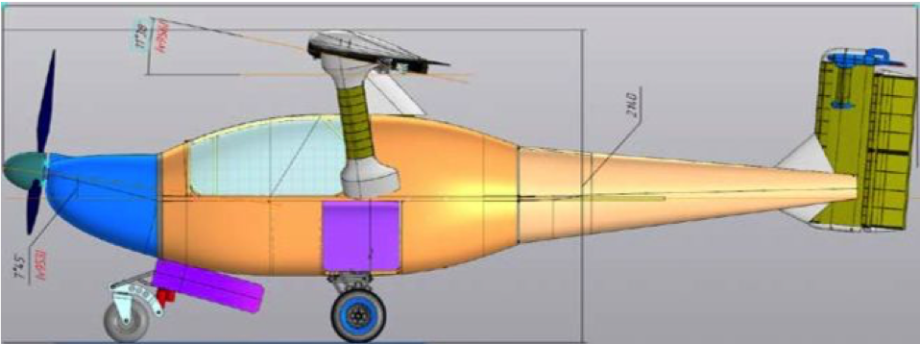


Geometrical characteristics of an ultralight aircraft and its main
The overall dimensions of the aircraft |
|
In flight condition |
|
Length | = 6.238 m |
Height | = 2.14 m |
Actual scope | = 7.523 m |
Maximum flight weight | = 650 kg |
Maximum flight altitude | 5000m |
Cruising speed | 100 km/h |
Take-off/landing strip length | 200m |
Payload : 300kg | 2pc OFAB 100-120 |
Maximum flight range | 900km |
Engine | 120 Hp |
Stall speed | 77 km/h |
When folded |
|
Length | = 6.238 m |
Height | = 2.326m |
Actual scope | = 1.908 m |
Chassis track | = 1.5 m |
Characteristics of aircraft units |
|
Wing |
|
Theoretical calculated area | = 5.72m2 |
The area is actual taking into account the KAP | = 5.82m2 |
The scope of the theoretical calculation | = 7.04 m |
The range is actual, taking into account the KAP | = 7.523 m |
Straight wing theoretical chord | = 0.82 m |
Medium aerodynamic chord | = 0.8125 m |
Geometric mean chord | = 0.774 m |
Wing elongation actual | = 9.718 |
Profile type – NACA 4417 modif. |
|
Relative thickness of the straight profile | = 17.2 % |
Characteristics of aircraft units |
|
Fuselage |
|
Fuselage length | = 5.832 m |
Fuselage width | = 1.374 m |
Maximum fuselage width | = 1.456 m |
Fuselage height | = 1.104m |
The area of the midsection of the fuselage | = 1.365m2 |
Equivalent fuselage diameter | = 1.318m2 |
The area of the wetted surface of the fuselage | = 13.472m2 |
Fuselage lengthening | = 4.42 |
Horizontal tail |
|
GO Area | = 1.02 m2 |
The scope of the GO | = 1.9 m |
Chord GO | = 0.542 m |
GO lengthening | = 3.54 |
Profile type – NACA 0010 |
|
Rudder chord | = 0.228 m |
Elevator span | = 1.644 m |
Relative area of RV | = 0.367 |
Vertical tail |
|
VO Area | = 0.8 m2 |
VO height | = 1.216 m |
Middle chord of VO | = 0.664 m |
Profile type – NACA0010 |
|
Precise Fertilization
Last years many fertilizer copters solutions came out.
Farmers invested and got disappointed.
Copters are not effective – use batteries and can take 15-20 kg fertilizer per flight The real operation turned to be cumbers, slow, ineffective and with high OPEX.
- The cheapest, fastest and most effective is still piloted fixed wing aircraft.:
- 24/7 operation. Can operate during night.
- Fully automated operation.
- No need to stop for rest
- The fastest solution. Covers large areas
- The most cost-effective solution